Documentation Index Fetch the complete documentation index at: https://prod-mint.classiq.io/llms.txt
Use this file to discover all available pages before exploring further.
View on GitHub Open this notebook in GitHub to run it yourself
The notebook shows how to construct the following state:
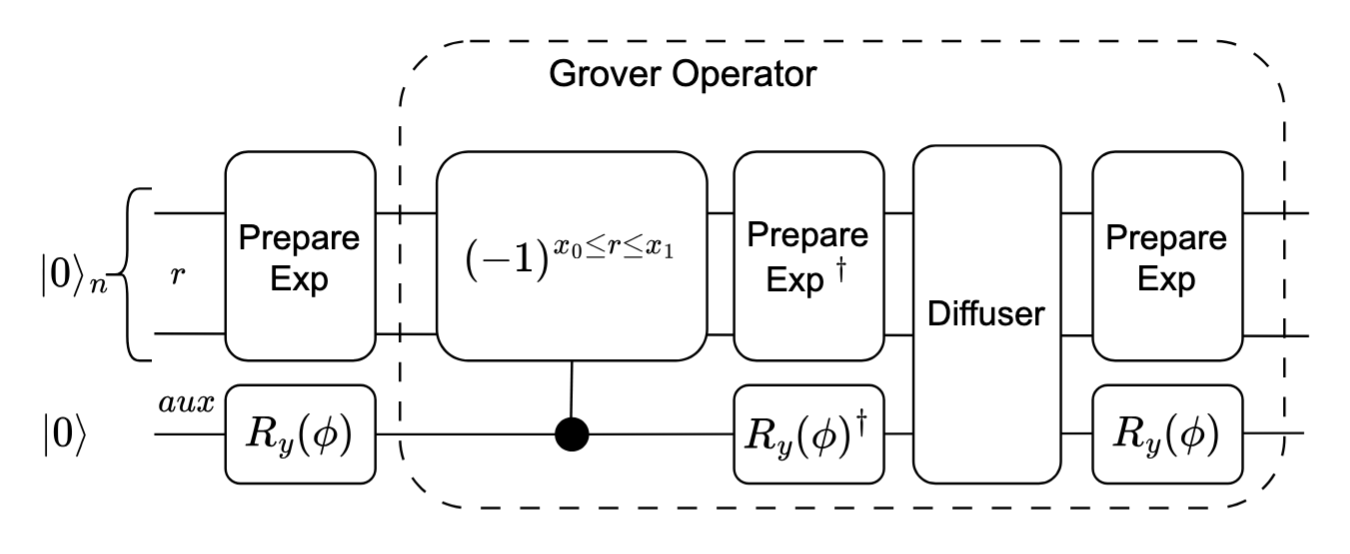
∣ ψ ⟩ = ∑ x 0 x 1 e − a r Z ∣ r ⟩ |\psi\rangle = \sum_{x_0}^{x_1}\sqrt{\frac{e^{-ar}}{Z}}|r\rangle ∣ ψ ⟩ = x 0 ∑ x 1 Z e − a r ∣ r ⟩ Z = ∑ x 0 x 1 e − a r Z = \sum_{x_0}^{x_1}\sqrt{e^{-ar}} Z = x 0 ∑ x 1 e − a r The methodology is to load the state on the full range of states, then use exact amplitude amplification to leave only the wanted part:
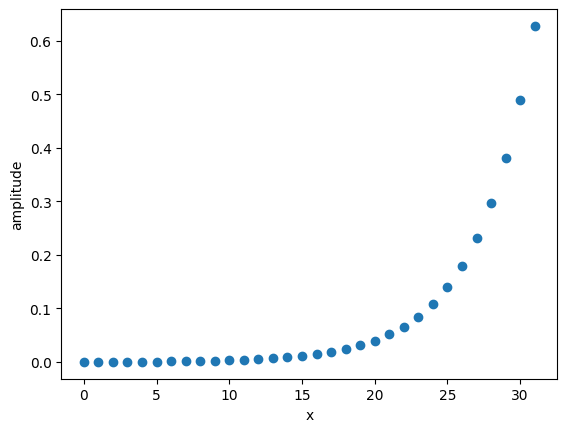
Exponential State Preparation on the Full Interval import matplotlib.pyplot as plt import numpy as np from classiq import * EXP_RATE = 0.5 NUM_QUBITS = 5 @qfunc def main ( x : Output[QNum]): allocate( NUM_QUBITS , x) prepare_exponential_state( - EXP_RATE , x) execution_preferences = ExecutionPreferences( num_shots = 1 , backend_preferences = ClassiqBackendPreferences( backend_name = ClassiqSimulatorBackendNames. SIMULATOR_STATEVECTOR ), ) qprog = synthesize(create_model(main, execution_preferences = execution_preferences)) res = execute(qprog).get_sample_result()
def parse_res ( r , plot = True ): x = [] amps = [] r = res for s in r.parsed_state_vector: if s.state[ "x" ] in x: amps[x.index(s.state[ "x" ])] += np.abs(s.amplitude) else : x.append(s.state[ "x" ]) amps.append(np.abs(s.amplitude)) if plot: plt.scatter(x, amps) plt.xlabel( "x" ) plt.ylabel( "amplitude" ) return x, amps x, amps = parse_res(res)
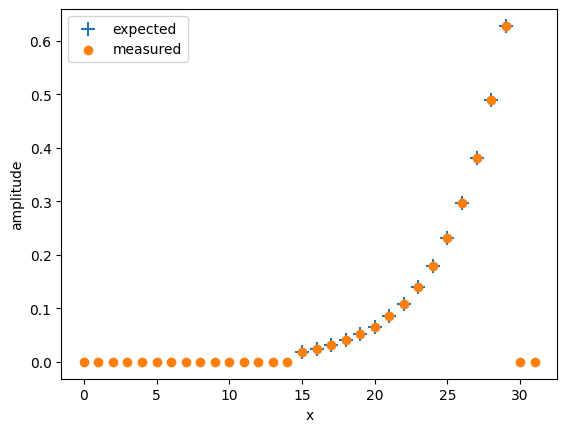
Exp State on a Specific Interval with Exact Amplitude Amplification X0 = 15 X1 = 29 X_MIN = 0 X_MAX = 2 ** NUM_QUBITS - 1 def get_good_states_amplitude ( x0 , x1 , exp_rate , num_qubits ): x_min = 0 x_max = 2 ** NUM_QUBITS - 1 """for the range[x0, x1] including x0 and x1""" return np.sqrt( (np.exp(exp_rate * x1) - np.exp(exp_rate * x0)) / (np.exp(exp_rate * x_max) - np.exp(exp_rate * x_min)) ) AMPLITUDE = get_good_states_amplitude(X0, X1, EXP_RATE , NUM_QUBITS ) print ( AMPLITUDE )
from classiq.qmod.symbolic import logical_and @qperm def oracle_comp ( x : Const[QNum], res : QBit): res ^= logical_and(x >= X0, x <= X1) @qfunc def main ( x : Output[QNum]): allocate( NUM_QUBITS , x) exact_amplitude_amplification( amplitude = AMPLITUDE , oracle = lambda _x : phase_oracle(oracle_comp, _x), space_transform = lambda _x : prepare_exponential_state( - EXP_RATE , _x), packed_qvars = x, ) qprog = synthesize(create_model(main, execution_preferences = execution_preferences)) show(qprog) res = execute(qprog).get_sample_result() x, measured_amps = parse_res(res, plot = False ) # compare to expected amplitudes grid = np.arange(X0, X1 + 1 ) expected_amps = np.sqrt(np.exp( EXP_RATE * grid)) expected_amps /= np.linalg.norm(expected_amps) plt.scatter(grid, expected_amps, marker = "+" , s = 100 , label = "expected" ) plt.scatter(x, measured_amps, label = "measured" ) plt.xlabel( "x" ) plt.ylabel( "amplitude" ) plt.legend() plt.show()
Output: Quantum program link: https://platform.classiq.io/circuit/2yrQCbA5Ri4kiCg6Z8Hr6f5ilEz
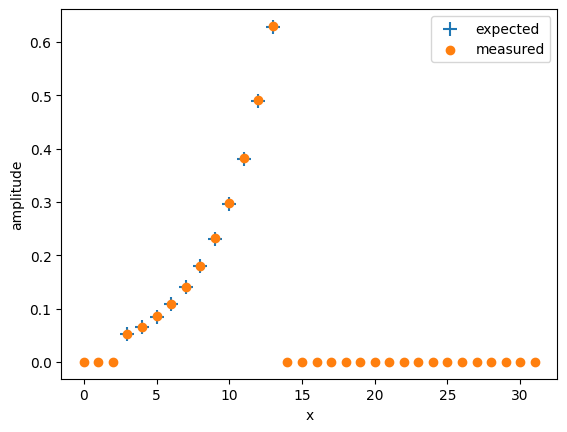
Adjusting If a Single Grover is Not Enough If the desired range does not hold enough amplitude, it is enough to load the end of the range (for a positive EXP_RATE) or the beginning of the range (for a negative EXP_RATE), then finish with a modular adder:
from classiq.qmod.symbolic import logical_and X0 = 3 X1 = 13 X_MIN = 0 X_MAX = 2 ** NUM_QUBITS - 1 AMPLITUDE = get_good_states_amplitude(X0, X1, EXP_RATE , NUM_QUBITS ) print ( AMPLITUDE )
This fraction of good states is not enough for a single Grover iteration to amplify to
So, first load the same sized interval at the end of the range:
X_MAX = 2 ** NUM_QUBITS - 1 if EXP_RATE > 0 : AMPLITUDE = get_good_states_amplitude( X_MAX - (X1 - X0), X_MAX , EXP_RATE , NUM_QUBITS ) else : AMPLITUDE = get_good_states_amplitude( 0 , X1 - X0, EXP_RATE , NUM_QUBITS ) print ( AMPLITUDE ) @qperm def oracle_comp ( x : Const[QNum], res : QBit): if EXP_RATE > 0 : res ^= x >= X_MAX - (X1 - X0) else : res ^= x <= (X1 - X0) @qfunc def main ( x : Output[QNum]): allocate( NUM_QUBITS , x) exact_amplitude_amplification( amplitude = AMPLITUDE , oracle = lambda _x : phase_oracle(oracle_comp, _x), space_transform = lambda _x : prepare_exponential_state( - EXP_RATE , _x), packed_qvars = x, ) # shift to the wanted domain if EXP_RATE > 0 : x += - ( X_MAX - X1) else : x += X0 qmod = create_model(main, execution_preferences = execution_preferences) qprog = synthesize(qmod) show(qprog) res = execute(qprog).get_sample_result() x, measured_amps = parse_res(res, plot = False ) # compare to expected amplitudes grid = np.arange(X0, X1 + 1 ) expected_amps = np.sqrt(np.exp( EXP_RATE * grid)) expected_amps /= np.linalg.norm(expected_amps) plt.scatter(grid, expected_amps, marker = "+" , s = 100 , label = "expected" ) plt.scatter(x, measured_amps, label = "measured" ) plt.xlabel( "x" ) plt.ylabel( "amplitude" ) plt.legend() plt.show()
Output: 0.996625424765961 Quantum program link: https://platform.classiq.io/circuit/2yrQI478Km0GkMYwVYXJ95cBlnZ
Verifying the Results x, measured_amps = parse_res(res, plot = False ) for i, amp in zip (x, measured_amps): if i >= X0 and i <= X1: assert np.isclose(amp, expected_amps[i - X0], atol = 0.01 )